NRAR issued the following media release today confirming the NSW Government has two sets of rules for irrigators with water users with
floodplain harvesting licences being treated inconsistently to all other water users - having no ability to nominate individual points of
take and alternative systems, when a primary measurement device is not yet operable. Thus confirming the NSW Government intends to undermine
the integrity of the process of issuing floodplain harvesting licences in the Gwydir Valley.
The Regional Skills Relocation Grant assists regional NSW businesses in identified industries attract skilled and specialised employees
from NSW metropolitan areas, interstate or internationally, to regional NSW. Grant amount: Up to $12,500 Application closes: 15 December 2023
The Regional Skills Relocation Grant aims to:
support economic growth in regional NSW by supporting businesses and organisations to find and attract skilled workers to live and work in
regional NSW
fill regional job vacancies
increase the strength, diversity and size of regional economies.
This program is funded and administered by Department of Regional NSW.
Despite a concerted effort by NSWIC, NIC and NFF on Thursday 30th November the Controversial Water Amendment Bill. Labour did deals with the greens and cross benchers to pass a bill which has not had any regulatory impact assessment done on it and has removed to critical
socio-economic considerations initially tied to the 450GL enhanced environmental outcomes for the southern connected system.
This means the 5GL over-recovery from the Gwydir can now be attributed to the 450GL.
On the day the various Senate reports on the Water Amendment Bill were released, we thought it might be time to re-release Cold Fish. A
humorous take on the serious issue of Cold Water pollution and the detrimental impacts it can have on native fish populations. It is
disappointing that the Government is not considering complementary measure as a critical element to improving the health of our rivers.
Instead, the Bill is focused on removing social economic considerations, removing the cap on buybacks and on chasing 450GL without regard to
the environmental measures it was intended to achieve.
DCCEEW hosted webinar about the Water Amendment Bill 2023 on 11 October 2023.
The webinar ran for 90 minutes with panel representatives from DCCEEW, MDBA, CEWH, BoM, ACCC and IGWC.
Questions raised during the webinar will be answered in the near future. Additional information from the department is available here
The Water engagement roundup is a live monthly webinar update about ongoing and upcoming engagements and consultation on important water
policy, reforms and programs for NSW. This month we focus on the NSW Groundwater Strategy.
Date: Wednesday, September 20, 2023
Time: 11:00 AM Australian Eastern Standard Time (New South Wales)
The Habitat Action Grants are funded from the Recreational Fishing Trusts which direct revenue generated by the NSW Recreational Fishing Fee
towards onground actions to improve fish habitat and recreational fishing in NSW.
Angling clubs, individuals, community groups, local councils and organisations interested in rehabilitating fish habitats in freshwater and
saltwater areas throughout NSW can apply for grants of up to $40,000.
Habitat rehabilitation projects which may be funded include:
removal or modification of barriers to fish passage
rehabilitation of riparian lands (river banks, wetlands, mangrove forests, saltmarsh)
re-snagging waterways with timber structure
removal of exotic vegetation from waterways and replace with native species
The Peter Cullen Water & Environment Trust invites applications from people who are actively involved in water and environmental
science, systems, advocacy, policy or management, to participate in our unique Leadership Program. This transformative Program is designed
to foster courageous leaders who will drive the sustainable and equitable management of Australia’s waterways and natural
environments. The PCT Leadership Program enables participants to develop their leadership capabilities, communication skills and
ability to drive change.
Limited to 16 participants, this remarkable journey significantly changes the clarity, confidence, shared vision and strategic capability
of each participant, and enhances their capacity to take up leadership roles within their organisations and communities.
Applications for the 2024 Leadership Program are now open, and will close on 15 October 2023. The 2024 Program will run
across two sessions: 17-22 March 2024 and 19-24 May 2024. Further group work and meetings will occur online between these two
sessions.
To apply for a position in the Program, please read the information provided in the links,
prepare your application material, and submit via the online application form prior to the closing date. To apply you will need a current
CV, statement of claim addressing the selection criteria, two current referees, and your ‘pitch’ for why you are the right match for this
Program.
Applications are open for the Australian Rural Leadership Program (ARLP), the flagship program of the Australian Rural Leadership Foundation
(ARLF). Over 30 diverse leaders from across rural, regional and remote Australia, come together for a series of unique and immersive
experiences to develop their leadership capabilities. The program takes place over 15 months and develops the capacity of individuals as
leaders in ways that are transformational in many, using face-to-face experiential learning supported by online engagement and peer-to-peer
mentoring.The program will commence in June 2024 and finish in September 2025 (four sessions with over 40 contact days). For more
information about the ARLP, visit https://rural-leaders.org.au/programs/australian-rural-leadership-program/ TO APPLY: You need to apply via our online platform -https://apply-rural-leaders.smapply.io/prog/australian_rural_leadership_program/.
You will need to register first.
The Australian Farm Data Code (the Code) was developed and adopted by the National Farmers’ Federation (NFF) in consultation with industry,
and with support from the Australian Government.
The Code is intended to inform the data management policies of product and service providers who manage data on behalf of farmers. It is
also a yardstick by which farmers can evaluate the data terms and policies of those providers. Benefits to farmers include:
increased awareness and understanding of the ways in which providers are collecting, using, and sharing their farm data;
a framework to compare providers and inform negotiations about data terms and policies; and
improvements to industry-wide data practices over time.
Benefits for service providers include: clear and agreed guidance on data policies and a helpful framework to inform
discussions with farmers about data.
Funding from the NSW Government through the NWLLS Has enabled the GVIA to manage the Gwydir Valley Strategic Pest Management
Initiative. The aim is to assist landholders monitor and manage feral pigs in the Gwydir Valley. The most effective management of feral pigs
involves a co-ordinated regional approach. As part of the project we are providing Gwydir Valley producers support for feral pig management. To get this support please complete the attached form and forward it with a copy of pig control invoices to Lou
Gall
at the GVIA office.
The Australian Government has announced consultation into ideas and ways to finalise the Murray Darling Basin Plan.
The Gwydir Valley has 5,000 ML of environmental water over the legal requirements for the Basin Plan and the consultation open at the
moment presents an opportunity to highlight this and the inequity that exists for the region who has over-recovered water compared with regions that have progress still to make.
WaterNSW are seeking views from customers and the community regarding water pricing values and outcomes for 2025-2030.
Considering it is water users that must pay for these outcomes and values, it is important that your views are received and
understood by WaterNSW. To make that happen we ask you to take the time to complete the survey.
The GVIA and other Customer Advisory Group members will have the opportunity to have input into this process but it starts with this
survey.
We are delighted that our Project Officer, Lou Gall has been awarded a new opportunity to enhance her governance education as part of the
Women’s Regional Rural & Remote Diversity Scholarship in partnership with @Australian
Institute of Company Directors
and with the support of the @Department
of the Prime Minister and Cabinet’s
Office for Women. Lou starts the program next month. #scholarships #governance.
There are a range of future scholarship opportunities available via the AICD website.
Following recent rainfall, WaterNSW have announced a 10% supplementary event for most sections of the rivers. If water users do not intend to take supplementary water, please contact WaterNSW so that can be reallocated.
See WaterInsights update for details.
NOTE: following this event, Tareelaroi Weir is again out of action to complete the refurbishment works required. This will mean you will not be able to order General Security or High Security allocation downstream of the weir until the works are complete. This is
planned to require around 7 weeks, up until end of May.
NSW Government has extended the Farms for the Future grants which are available in our region.
These grants provide opportunities to upgrade your farm ag technology and connectivity improvements.
You must complete an online training program and farm plan to be eligible. Note also this program can be used for selected government telemetry connectivity and selected secondary devices for floodplain harvesting measurement.
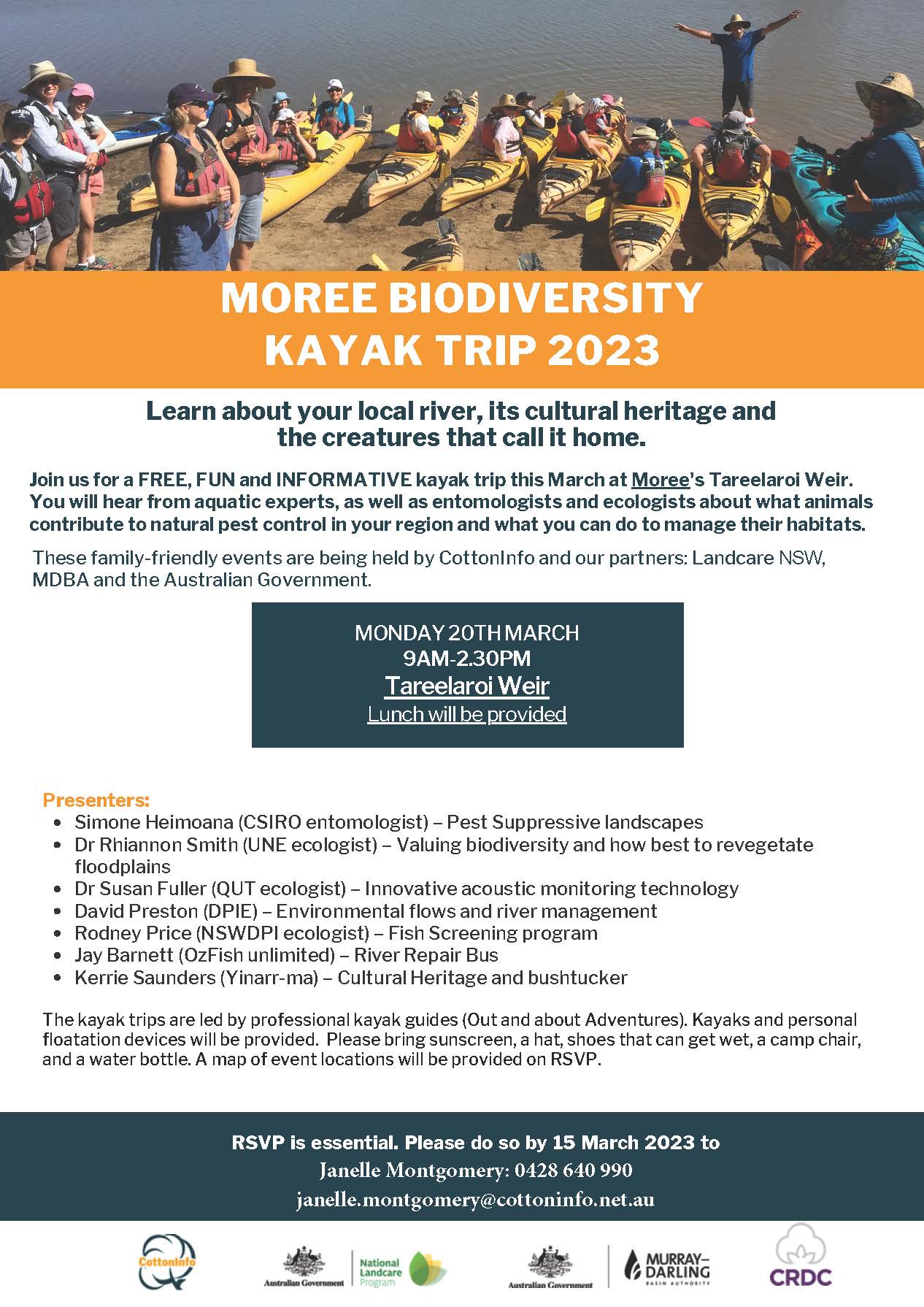
Monday 20th March - Learn about your local river, its cultural heritage and the creatures that call it home.
Join CottonInfo for a FREE, FUN and INFORMATIVE kayak trip at Moree's Tareelaroi Weir. You will hear from aquatic experts, entomologists and ecologists about what animals contribute to natural pest control in your region and what you can do to manage their
habitats.
Presenters: Simone Heimoana (CSIRO entomologist) – Pest Suppressive landscapes, Dr Rhiannon Smith (UNE ecologist) – Valuing biodiversity and how best to revegetate floodplains Dr Susan Fuller (QUT ecologist) – Innovative acoustic monitoring technology David Preston (DPIE) –
Environmental flows and river management, Rodney Price (NSWDPI ecologist) – Fish Screening program, Jay Barnett (OzFish unlimited) – River Repair Bus, Kerrie Saunders (Yinarr-ma) – Cultural Heritage and bushtucker
Sundown Pastoral Company would like to invite you to join them for the 2022 Bayer Grower of the Year Field Day at Keytah, Moree on
21st February 2023
from 10am.
Industry-led panel sessions will explore:
1. Carbon and Greenhouse Gas Emissions.
2. Customer expectations along the value chain.
3. The power of Supply Chain Traceability.
4. Adaptive Agriculture and Innovative Solutions for Growers
5. Practical Applications and Field Innovations
Please see your invitation included. A detailed agenda is available here.
Could you please share this information with your network as this will be a fantastic day where all aspects of the cotton supply chain from
field to fabric will be explored. .
We hope to see you there! Please RSVP for catering purposes.
Tocal College are taking applications for their WHS &
HR Fundamentals course (online).
The course is designed for business owners, managers and supervisors and is delivered as 3 distinct topics (WHS, industrial relations and managing your team) over 16 weeks. It starts Feb 20th, with applications closing Friday (Feb 3rd).
The Australian Government Long-term Trials of Drought Resilient Farming Practices Program is open. The program will support grants valued up
to $8 million per grant. The program will fund innovative and transformational practices that have the potential to positively influence (socially, economically and/or environmentally) the efficiency, productivity, and sustainability of Australian farms from the impacts of drought and climate change.
Projects will test, refine, and demonstrate the effectiveness (or otherwise) of yet to be proven farming practices in a robust scientific
manner. The testing of these practices will underpin and assist to drive widespread adoption through increased evidence and by providing
farmers with the confidence and information they need to try the practices themselves.
Expressions of Interest (EIO) for the Regional Job Creation Fund are open. Attracting new investment to the regions and boosting job security will be the focus of the next round of the NSW Liberal and Nationals Government Regional Job Creation Fund. The Regional Job
Creation Fund will provide grants for regional businesses to expand operations and attract interstate and international businesses to
relocate to regional NSW.
Eligible businesses can apply for grants of between $100,00 and $10 million for projects such as replacing plant equipment, upgrading technology and ensuring businesses that might otherwise have to relocate can remain based in regional areas.
Expressions of Interest for Round Three will close 5pm Monday, 6 March 2023. Successful EOI applicants will be invited to submit
detailed applications from May 2023.
Moree Chamber have forwarded a couple of Flood Impact Surveys. These help inform both local and state governments and may assist in
future aid packages. It is important that these surveys provide information on impacts from businesses across our shire, so we would
appreciate it if you could please complete them - it takes 2 minutes.
The Gwydir is one of the first four regional water strategies that have been finalised by the Department of Planning and Environment. The
plan covers three Priority areas;
1. Water for critical human and environmental needs
2. Sustainable water resources for new and existing users
3. Best use of existing water for the environment
New local intelligence devices available for non-urban water metering
New local intelligence devices available for non-urban water metering reform
Three telemetry-enabled local
intelligence devices
(LIDs) have been listed for use for non-urban metering, including one which can transmit data from multiple meters.
The FlowPRO Multipoint Monitoring System is the first listed LID that supports the transmission of data from multiple meters. It is a
cost-effective solution for water users who can now purchase a single LID for use with up to 4 meters.
NSW Government is requesting landholders impacted by recent flooding to report damages using the Natural Disaster Survey via the link
below.
This information will be used to seek assistance and target the Government's response. It includes and esitimate of crop losses,
infrastructure and repairs.
For isolated members needing emergency assistance for food supplies and medication contact SES 132 500.
The Gwydir River peaked at Gravesend at 11:45pm on Friday 21st October 2022 at a height of 16.20m. as of 10am on Saturday 22nd October 2022 the Gwydir was falling at Gravesend, steady at both Pally and Yarraman. The Mehi was rising in Moree at this time. Please visit the History of Flooding page on our website for more information. Gwydir
Valley Irrigators Association Inc - History Of Flooding (gvia.org.au)
We have also linked to the MPSC website with more information.
For updates on Copeton Dam operations, which is under airspace management and adjusting releasing according to actual and forecast inflows,
you are encouraged to register for the Early Warning Network via WaterNSW the river operators.
This year Mr Bernie George was awarded the prestigious Incitec Pivot Fertilisers Service to Industry Award. Bernie is the Water Services and Compliance Manager at Australian Food & Fibre. Bernie has been delivering excellence in service to the cotton industry
through various high-profile roles for over 30 years. He has worked in the Gwydir having been instramental in the development of the Auscott Midkin aggregation, and has represented various industry organisations including as Chair of the Cotton Australia Board and as a member
of the National Irrigators Council and NSW Irrigators Council. It is wonderful to see Bernie recognised for his committment to the cotton
and irrigation industry.
Keytah was announced as the 2022
Cotton Grower of the Year
at the Australian Cotton Conference. Nick Gillingham, Keytah General Manager along with owners David and Danielle Statham are pictured
receiving the award in August. Sundown Pastoral Company have been actively involved in irrigation efficiency research since 2009, they have
willingly shared their experiences and understanding to help other producers adopt new and innovative technologies. The team are also
farming St Ronans in Qld and have been instrumental in the creation of the Good Earth
Cotton
Company and FibreTrace. This award is well deserved and highlights that the
Gwydir is still at the forefront of the Australian Cotton Industry.
At last NSW DPE recently confirmed that there is a new exemption for metering conditions for "works used solely
to take water under a basic landholder right".
This means, groundwater works in particular those that have an water access licence attached to the work ("the bore") but
you do not use it to irrigate, rather you only use it for stock and domestic purposes are now exempt from metering requirements. This
exemption is welcomed considering the cost implications for individuals with little benefit to the reform outcomes, as there is no water
being used for irrigation anyway.
You may want to inform WaterNSW to tag your work as not active for irrigation, however it is not a requirement.
The below link refers to all the current exemptions available.
NSW DPI Fisheries is seeking Expressions of Interest (EOIs) from water users who would like financial and logistic assistance to upgrade their water diversion (pump or gravity-fed channel) with a modern fish-protection screen.
Modern screens keep fish and debris where they belong – in the river and out of infrastructure. They feature a large self-cleaning surface
area that maintains the volume of water extracted, while using a fine mesh that limits the extraction of fish from our rivers.
We encourage all members with surface water offtakes to apply, regardless of whether you are located in the priority area along the
Mehi River or not.
Applications are easy - just your works details and descriptions. Visit the website for more information EOI
- Fish Screens Australia
Water NSW have announced a rescheduling of the regulator works at Tarelaroi Weir until April 2023.
Works to have the regulator back fully operational will need to occur prior to the commencement of this season's delivery which will result in a 1-2 week shut down period for the Mehi/Moomin. The gates must be properly reinstalled to allow full operations.
WaterNSW confirmed today that all the approvals have been implemented to enable floodplain harvesting licences in the Gwydir Regulated
River Water Source and the Gwydir Unregulated Water Sources, where there is a licence with allocation available to take water.
The announcement confirmed that these licences can be used provided the total storage in Menindee Lakes is greater than 195GL. The Menindee Lakes currently have a total of 1,958 GL storage or at 113% capacity, which is 1000 times more water than the drought
limit triggers which restrict floodplain harvesting access. Restrictions are also removed when local in-valley flow targets can be achieved,
these our outlined for each management zone in the WSP.
For a copy of the announcement, visit WaterInsights.
DPE have made an allocation announcement for supplementary entitlements of 0.79 megalitres per unit share brining supplementary entitlements
to 100% availability, this has come in response to the issuing of replacement floodplain harvesting licences in the regulated and
unregulated water sources with water availability of 1 megalitre per unit shares. These licences are now fully enabled.
This for the first time brings all licences into the water management framework and with 100% availability for all forms of take with
general security accounts at their maximum of 150%.
I'll note Copeton Dam remains on spill operations to maintain capacity to 100% and more information is available on our webpage linked below.
In a milestone for water management in the region, the NSW Water and Environment Minister’s jointly amended the Gwydir’s water sharing plans
to include floodplain harvesting, the take of water during floods.
This is the final form of water in the region to be licensed and has taken 20 years of delays and deliberations with licences to begin by 1
September 2022.
Zara Lowien, the Executive Officer of the Gwydir Valley Irrigators Association whose members will be the first in NSW to be licenced for
this form of take said this is not a win for northern irrigators, as it's often portrayed.
"On average water users in the Gwydir are losing 30% of their long-term access to flood water which will have more than a $90 million impact to our economy through less production" she
said.
"Make no mistake, this is an environmental reform like no other.”
The Water Sharing Plan for the Gwydir Regulated River Water Source and the Gwydir Unregulated Water Sources were amended and made
available on Friday, 29 July 2022.
The updates include the floodplain as a source of water and the new account management, access and dealing rules for replacement floodplain harvesting licences which are due to commence no later than 1 September 2022. This is a major milestone for the near completion of the Healthy Floodplains Program in our region.
Update were also made to make these plans consistent with rules for the Basin Plan.
The Mehi River has been flowing quickly through Moree as Copeton Dam spilled to make room for recent inflows. These flows were largely shared between the Carole Ck and the Mehi River. The releases were then used to fulfil orders for water users who are planning to
irrigate wheat and ensure on farm supplies are ready for the upcoming cotton season.
Releases from Copeton peaked at 7,000 ML per day and have reduced to 1,600 ML per day. Currently, there is just under 3,000ML/day
visible under the bridge through town as per the picture.
WaterNSW are actively managing Copeton Dam to 99% capacity unless water orders reduce this volume.
The NSW Government has released a draft Groundwater Strategy which is currently open for consultation. The Strategy is available here
for review.
Public webinars are available on 25th and 28th of July to hear about the strategy and its objective and priorities.
The Gwydir region relies on a number of groundwater sources to maintain production during droughts as well as stock and domestic use around
the catchment. Groundwater also supplies many of our towns and commercial businesses.
The GVIA will be participating in the public and targeted information sessions prior to preparing a submission. Please click the link for
more information or to register for one of the public information webinars.
Carbon is one of the topics getting attention at present. It is important for our members to understand what it means for them. To help
we are hosting the Gwydir Regional Carbon Forum in partnership with UNE, NSW DPI and the CRDC. We are looking to provide information on
Sustainable Soil Management and how this links with a productive cropping system and Carbon.
What is soil Carbon: Understanding, monitoring and measuring soil carbon. What levels could be expected as a baseline? What
do producers need to know before they make any changes? How can they use existing/historic soil tests?
Understanding and measuring emissions: What is involved in making this assessment and how should producers go about collecting the
information.
Data management: What data do producers need, where can it be stored, how can this be easily managed over time.
Tools that can assist producers and agronomist easily manage the Carbon space.
When: 3rd August 2022 Where: Town and Country Club, 5 Frome St, Moree Start: 2:00pm
The NSW Government as enabled the establishment of replacement floodplain harvesting licences and mandatory metering conditions in regulation on 1 July 2022.
These regulations provide the framework to determine, issue and implement floodplain harvesting licencing in NSW.
The regulations provide for a temporary exemption to take rainfall run off collected in irrigation tailwater drains when no other overland
flow is being intercepted - i.e. outside of floods. This enables a consistent approach around NSW to ensuring irrigators can
adopt best management practices and implement required environmental safeguards.
There were minor amendments to these regulations which can be summarised here.
Local valley based water sharing plans must be amended to reflect the local implementation of these replacement licences.
Copeton Dam is at 99% capacity with approximately 35,000 ML of surplus water available for allocation to accounts with airspace. Currently all accounts are at their maximum and do not have airspace.
Copeton Dam is being carefully managed to a safe capacity. This means releases will beginning to occur to make airspace for
upstream inflows.
Spill releases trigger unregulated flow rules below Copeton Dam and can be accessed as supplementary or higher priority licences such as
general security of high security. Currently, WaterNSW have an expression of interest open for supplementary access. Supplementary allocations are currently reduced to 21%.
Local water utilities and High Security Licences received 1 ML per unit share or 100% allocation. These licences are secured with
reserves for 2-years.
General Security Licences are at their full account of 150% and therefore, no allocations were made as users carried over that water. Copeton Dam remains at 99% meaning there is surplus water available for allocation for accounts that have airspace. The next allocation is due before 7 July 2022.
Supplementary Licences received only 0.21 unit share of 21% allocation. This reduction is a direct response to the failure to issue floodplain harvesting licences and update the Water Sharing Plan for the Gwydir Regulated Water Source.
1ML unit share announcement was made for aquifer licences with 100% allocation to local utilities.
This announcement includes the Lower Gwydir Groundwater water source, the Great Artesian Basin water sources and Fractured Rock
water sources across the Valley.
The next draft of the Gwydir Regional Water Strategy is open for consultation this month with submissions due by 29 June 2022. The strategy aims to provide a forward plan for priorities and actions for the region to work towards building resilience within our communities
and industries through variable conditions.
The GVIA attended the public sessions in Inverell and Moree this week where concerns regarding the lack of infrastructure options, the need
for a forward thinking and equitable policy framework and the challenges with water delivery for all water users in extended dry
periods was discussed.
A webinar will be hosted on 20 June 2022 for more information visit the Department website.
Gwydir High Security and General Security water users will end the water year with full accounts, as Copeton Dam remains full at 99% with
accounts again topped up to the full limits.
There remains 34.3GL surplus water in Copeton Dam even after this last announcement which can be allocated to accounts with airspace.
IPART NSW have finalised water prices for the 2022-23 water year, agreeing to inflation only increases. The outcome will see a 5.1%
increase and will be felt by all water users, who are encountering significant input cost rises across their businesses. With water
availability high the cost increase will come at a time with farm production is also at its peak. However users on a one-part tariff
who do not use their allocation or licence this year, will need to absorb the increase as they have less opportunity to offset the
rise through increased production.
We have updated the pricing page with the current information.
This month DPIEW confirmed that all stored regulated accounts are again at their maximum level, with excess water stored in Copeton Dam. This brings the years total allocation to 413% which is an odd way of explaining that accounts have been full and spilling since
December 2021, only those with airspace can receive the available water.
There is excess water available for sharing remaining in Copeton Dam when the dam is higher than 95%, the most recent resource assessment had 1,300ML surplus water available for next months allocation announcement (provided their is account airspace).
This months resource assessment provided a further 8.6% allocation to general security accounts, with the ECA and environmental water
accounts at maximum level. Irrigation water availability is just below the 600GL maximum account limit.
The main summer irrigation season is drawing to a close and deliveries to the Gwydir Wetlands are also slowing down, which should see
releases at Copeton Dam ease off and the majority of this water carried over for future use.
Copeton Dam is holding steady at 93% capacity which means there is plenty of water to enjoy at the Holiday Park. At this level at the end of the irrigation season we anticipate, a few good years of economic activity from the stored water.
NSW DPIEW now regularly track groundwater extractions against the long-tern annual average extraction limits allowed in water sharing plans. This replaces the updates that we used to provide.
To report and status of groundwater regions is available from the Department's website.
Currently, extractions in the Lower Gwydir are well below limits although account water availability is high. The valley is deemed to have a medium risk to breaching limits but we see this as unlikely given the high surface water availability and low extraction to date. To
ensure the register has the most current usage information, please provide usage updates in iWas, where there is no telemetry automating your usage information.
NSW DPIEW are providing an update on groundwater levels in the Gwydir Valley on Tuesday, 15th March 2022 - 9:30- 11:30am. This
meeting is a face to face meeting in Moree at the Services Club.
Groundwater levels have generally fluctuated within acceptable levels of decline and recovery. However, in some localities, with
concentrated areas of pumping, groundwater levels are not able to fully recover before the following irrigation season starts. The
Department have more information on this and have provided a brief report accessed via the below link.
Join us for discussions on the Siphon-less tailwater backup design at Saunders Farming "Thuraggi Overflow" St George on Tuesday
8th March 2022. The field day is the second half of the CSD Cotton Management Field day.
The irrigation session will start at 10am with an update on the Water productivity benchmarking followed by an introduction to the system
from Craig Saunders. We will then have a panel session with Glenn Lyon, Lucas Wuersching, Andrew McKay, Grant Oswald and Malcolm
Gillies to discuss the design, the performance and some of the considerations for implementation.
We will be leaving Moree a 7am on Tuesday. Please contact Lou on 0427521498
Conditions are looking better in the Gwydir Valley for farmers and the environment. Natural river flows in 2020 and early 2021 started the process, with further rainfall, flows and flooding in 2021 and ongoing river flows in 2022. This has helped improved water
availability for farmers but has also encouraged the return of many water birds to the region this year, which is the most significant bird
breeding event since 2012. NSW and Commonwealth agencies have been monitoring the environmental condition of the region and have
provided updates following aerial surveys in December 2021 and January 2022 with five colonies of birds breeding and four of these
containing 1,000 to 2,000 nests each.
The bird breeding event, triggered from natural inflows is being supported by existing water sharing rules as well as water owned by
governments for environmental purposes. For more information on water for the environment visit our page
or the Commonwealth Environmental Water Office updates.
DPIEW have announced the latest water availability with a 40% allocation bringing this years total to 160.4%; general security accounts have a 150% limit and the environmental contingency allowance has 200%. All of these accounts are full, with 36,100 megalitres of
surplus unallocated in Copeton Dam.
The Dam remains steady at 96% with deliveries from some stream flows occurring, dam releases equalled inflows of 215,000
megalitres with around 64,000 megalitres ordered by licence holders during the time.
The Natural Resources Commission is undertaking their audit and review of the Water Sharing Plan for the Gwydir Unregulated Water
Sources 2012, due every 10-years. Previous reviews by the NRC have been controversial as in the 5-year review of the Barwon Darling (here)
resulting in significant changes including, active management, increased commence to pump thresholds and new restrictions following drought
periods called resumption of flow rules.
The key areas as guided by the NRC are:
Environmental outcomes: examples of how the plan rules provide for environmental outcomes.
Social outcomes: examples of how has having ‘a plan’ allowed for improve social outcomes for you, your region and community.
Economic outcomes: examples of the value of a licence, clear rules and a trading market.
GVIA will be preparing a submission which is due on 6 February 2022. You can provide your own submission or to see more see the NRC
Review.
The NSW Government finally issued an exemption and outlined the process to apply for water users who do not have enough network connectivity (are in a black spot) to install a telemetry unit on their compliant water meter site. This exemption comes after raising this issue
since 2017 and NRAR issuing letter of advice to water users who had not been able to be fully compliant because of this issue.
There are three steps to apply for this exemption, which allow water users or duly qualified persons to identify whether a site is within network coverage and to apply using the standardised form. Please ensure this exemption is added as an update to your file in
the DQP portal so that all agencies have access.
We are continuing to work through the remaining outstanding issues that require an exemption.
WaterNSW have eased Copeton Dam releases and they remain steady since 14 December, with 1,500 megalitres per day being released.
Flood warnings have ceased for the Gwydir Valley in response, with the tail of the released water expected to pass through all of the effluent creeks and streams now that flow rates are within the scope of operations of the river infrastructure.
For information on river heights, visit WaterInsights.
As flood waters continue to move along our river systems now reaching western communities such as Mungindi, Collarenebri and Walgett and
spill operations for major storages continuing, including the recent addition of Menindee Lakes. This flooding is occurring as the NSW
Upper House report into Floodplain Harvesting[1] declared the historical practice is legal and should be measured and
licenced.
“The community rightly expect, is that whenever industry has access to water, it is only to our share, that the limits are policed and that
it is very transparent, even in floods when there is water everywhere” she said.
“We agree and that is why we’ve supported the licencing of Floodplain Harvesting - a long-standing, historical form of take that
happens when rivers and our floodplains are spilling, so that all forms of take are consistently managed in our valley” she said.
“Our position was supported by the Upper House Committee report which highlighted the need for measurement of storages and our rivers to
properly account for water use and licencing to ensure all limits in state and Federal legislation could be achieved and monitored”.
“These are all key elements of the reform which the majority of stakeholders agree, it is what the community expects and should be
implemented state-wide” she said.