The Regional Skills Relocation Grant assists regional NSW businesses in identified industries attract skilled and specialised employees
from NSW metropolitan areas, interstate or internationally, to regional NSW. Grant amount: Up to $12,500 Application closes: 15 December 2023
The Regional Skills Relocation Grant aims to:
support economic growth in regional NSW by supporting businesses and organisations to find and attract skilled workers to live and work in
regional NSW
fill regional job vacancies
increase the strength, diversity and size of regional economies.
This program is funded and administered by Department of Regional NSW.
Despite a concerted effort by NSWIC, NIC and NFF on Thursday 30th November the Controversial Water Amendment Bill. Labour did deals with the greens and cross benchers to pass a bill which has not had any regulatory impact assessment done on it and has removed to critical
socio-economic considerations initially tied to the 450GL enhanced environmental outcomes for the southern connected system.
This means the 5GL over-recovery from the Gwydir can now be attributed to the 450GL.
On the day the various Senate reports on the Water Amendment Bill were released, we thought it might be time to re-release Cold Fish. A
humorous take on the serious issue of Cold Water pollution and the detrimental impacts it can have on native fish populations. It is
disappointing that the Government is not considering complementary measure as a critical element to improving the health of our rivers.
Instead, the Bill is focused on removing social economic considerations, removing the cap on buybacks and on chasing 450GL without regard to
the environmental measures it was intended to achieve.
THe NSW Government are currently reviewing the non-urban metering framework. Submissions are due Sunday 26th November. We would appreciate
any feedback you may have to include in our submission.
The primary areas where we will be focusing are: The Data Aquisition System (DAS) and the issues associated with its functionality, Flood
Plain Harvesting the practicality of the policy and the barriers to compliance, Availability of Duly Qualified Persons (DQP's) and
availability of suitable meters.
The issues and options discussion paper is available at the included link.
Gwydir Valley Gwydir Valley Channel Capacity Constraints
18 October 2023
WaterNSW advises customers in the Gwydir Valley that if conditions continue to remain dry, demand is expected to exceed channel capacity
throughout the upcoming summer irrigation season. Channel capacity restrictions will occur on the Lower Gwydir below Tyreel Regulator and are also likely to affect the Carole/Gil Gil Creek and Moomin Creek.
Rostering of available water will need to be implemented as was last experienced in 2017/18. Further information on individual licence unit shares that WaterNSW will utilise to implement channel capacity rostering will be provided at a later date.
Water orders can be placed by accessing iWAS at https://iwas.waternsw.com.au/iwas/login.iwas
Water ordering information can be found at the WaterNSW website https://www.waternsw.com.au/customer-services/ordering-and-trading/ordering-water
For account enquiries please contact 1300 662 077.
Recently the GVIA submitted to the Natural Resources Commission review into the Gwydir Regulated Water Sharing Plan. The Submission included a range of recommendations covering how the plan contributed to environmental, social, cultural and economic outcomes. We raised concerns
regarding the use of section 324 temporary restriction orders, FPH zones and trade limitations, channel capacity and the need for the
Minister’s decision regarding supplementary water events to rigorously assess the potential for small supplementary flows in the Gwydir to contribute to the Barwon-Darling requirements. The GVIA recommended that there needed to be greater certainty for stakeholders around
these limits and decisions to implement any limits or restrictions to supplementary access, to achieve Schedule 2 outcomes, a framework
should be established as part of the long-term planning arrangements.
The GVIA submission included 9 recommendations. In principle the extension of the time frames is constructive, there are however so other issues which are concerning. The following recommendations were included in the submission;
The GVIA recommends that over-recovered water be returned to the Valleys where it was acquired to enhance the
sustainability of the environment and the communities within those valleys. We do not support the allocation of water that cannot contribute
to environmental outcomes in the southern connected system being allocated to the 450GL water for the environment.
The GVIA recommends that socio-economic criteria for all programs under the 450GL target remain.
The GVIA recommends the reinstatement of the 1,500GL limit on water purchases.
The GVIA recommends the removal of “from time to time” to be replaced with a fixed time period, aligning with the completion all other
measures within the Murray Darling Basin Plan (2012).
DCCEEW hosted webinar about the Water Amendment Bill 2023 on 11 October 2023.
The webinar ran for 90 minutes with panel representatives from DCCEEW, MDBA, CEWH, BoM, ACCC and IGWC.
Questions raised during the webinar will be answered in the near future. Additional information from the department is available here
The Water engagement roundup is a live monthly webinar update about ongoing and upcoming engagements and consultation on important water
policy, reforms and programs for NSW. This month we focus on the NSW Groundwater Strategy.
Date: Wednesday, September 20, 2023
Time: 11:00 AM Australian Eastern Standard Time (New South Wales)
The NSW Government have developed a Metering and Measurement Virtual Marketplace for water users to find and connect with installers and suppliers of non-urban metering and floodplain harvesting measurement equipment.
The NSW Government has committed to reviewing domestic and stock rights as part of the NSW Water Strategy (action 1.6). This survey is part of phase 1 of the review, which is focused on gathering and sharing information through community engagement. Feedback received
through the survey will help the government understand the level of awareness of domestic and stock rights and how these rights are
understood, used and perceived. A summary of the findings of the survey and how they will inform the review will be published on our
website.
The Habitat Action Grants are funded from the Recreational Fishing Trusts which direct revenue generated by the NSW Recreational Fishing Fee
towards onground actions to improve fish habitat and recreational fishing in NSW.
Angling clubs, individuals, community groups, local councils and organisations interested in rehabilitating fish habitats in freshwater and
saltwater areas throughout NSW can apply for grants of up to $40,000.
Habitat rehabilitation projects which may be funded include:
removal or modification of barriers to fish passage
rehabilitation of riparian lands (river banks, wetlands, mangrove forests, saltmarsh)
re-snagging waterways with timber structure
removal of exotic vegetation from waterways and replace with native species
Water Currently Available for Temporary trade
The GVIA have available 16 ML (megalitres) of Lower Gwydir Groundwater allocation for sale. You can bid in price/megalitre by
emailing lou.gall@gvia.org.au before 5pm Tuesday, 31st October 2023. The buyer will be
required to cover the WaterNSW fee of $332.88 (GST Free) and the GVIA transaction fee of $55.00 (Inc GST).
Improve the rate and reach of R&D adaption and adoption
Enable successful cotton industry expansion
Respond to biosecurity threats and assist in the event of natural disasters
The Role
With the incumbent moving on, there is now the need for a replacement CottonInfo Program Lead. Reporting to the CRDC GM
Communications and Extension and working closely with the joint venture partners, the role is responsible for leading the extension program
and supporting a team facilitating the adoption of R&D in the Australian cotton industry.
The CottonInfo Program Lead is responsible for shaping, implementing and delivering against the CottonInfo strategic plan in this execution
role, influencing the team delivering key information to market.
This includes delivering on KPI’s around:
The Peter Cullen Water & Environment Trust invites applications from people who are actively involved in water and environmental
science, systems, advocacy, policy or management, to participate in our unique Leadership Program. This transformative Program is designed
to foster courageous leaders who will drive the sustainable and equitable management of Australia’s waterways and natural
environments. The PCT Leadership Program enables participants to develop their leadership capabilities, communication skills and
ability to drive change.
Limited to 16 participants, this remarkable journey significantly changes the clarity, confidence, shared vision and strategic capability
of each participant, and enhances their capacity to take up leadership roles within their organisations and communities.
Applications for the 2024 Leadership Program are now open, and will close on 15 October 2023. The 2024 Program will run
across two sessions: 17-22 March 2024 and 19-24 May 2024. Further group work and meetings will occur online between these two
sessions.
To apply for a position in the Program, please read the information provided in the links,
prepare your application material, and submit via the online application form prior to the closing date. To apply you will need a current
CV, statement of claim addressing the selection criteria, two current referees, and your ‘pitch’ for why you are the right match for this
Program.
Applications are open for the Australian Rural Leadership Program (ARLP), the flagship program of the Australian Rural Leadership Foundation
(ARLF). Over 30 diverse leaders from across rural, regional and remote Australia, come together for a series of unique and immersive
experiences to develop their leadership capabilities. The program takes place over 15 months and develops the capacity of individuals as
leaders in ways that are transformational in many, using face-to-face experiential learning supported by online engagement and peer-to-peer
mentoring.The program will commence in June 2024 and finish in September 2025 (four sessions with over 40 contact days). For more
information about the ARLP, visit https://rural-leaders.org.au/programs/australian-rural-leadership-program/ TO APPLY: You need to apply via our online platform -https://apply-rural-leaders.smapply.io/prog/australian_rural_leadership_program/.
You will need to register first.
The Australian Farm Data Code (the Code) was developed and adopted by the National Farmers’ Federation (NFF) in consultation with industry,
and with support from the Australian Government.
The Code is intended to inform the data management policies of product and service providers who manage data on behalf of farmers. It is
also a yardstick by which farmers can evaluate the data terms and policies of those providers. Benefits to farmers include:
increased awareness and understanding of the ways in which providers are collecting, using, and sharing their farm data;
a framework to compare providers and inform negotiations about data terms and policies; and
improvements to industry-wide data practices over time.
Benefits for service providers include: clear and agreed guidance on data policies and a helpful framework to inform
discussions with farmers about data.
Funding from the NSW Government through the NWLLS Has enabled the GVIA to manage the Gwydir Valley Strategic Pest Management
Initiative. The aim is to assist landholders monitor and manage feral pigs in the Gwydir Valley. The most effective management of feral pigs
involves a co-ordinated regional approach. As part of the project we are providing Gwydir Valley producers support for feral pig management. To get this support please complete the attached form and forward it with a copy of pig control invoices to Lou
Gall
at the GVIA office.
The Australian Government has announced consultation into ideas and ways to finalise the Murray Darling Basin Plan.
The Gwydir Valley has 5,000 ML of environmental water over the legal requirements for the Basin Plan and the consultation open at the
moment presents an opportunity to highlight this and the inequity that exists for the region who has over-recovered water compared with regions that have progress still to make.
WaterNSW are seeking views from customers and the community regarding water pricing values and outcomes for 2025-2030.
Considering it is water users that must pay for these outcomes and values, it is important that your views are received and
understood by WaterNSW. To make that happen we ask you to take the time to complete the survey.
The GVIA and other Customer Advisory Group members will have the opportunity to have input into this process but it starts with this
survey.
Users with meters but no telemetry - if you have installed a compliant meter, your water usage is recorded by your local
intelligence device (LID) to be downloaded once a year by the customer field officer.
There is only a requirement to report that usage monthly if telemetry is not installed - this can be achieved via iWas, or
via the online the reporting options.
Users who have pumping conditions (likely unregulated water users) - if you have a cease to take condition on your licence
or work approval, you must complete a 'cease
to take conditions do not apply form'
when taking water.
This form must be kept on file with any other reporting requirements, for up to five-years.
This recording requirement is in addition to any recording and reporting requirements for your water take, which is explained in the the
other posts - Reporting - meters without telemetry and reporting - when there is no meter requirement.
Users who do not need a meter - if it is determined via a DQP or via the use of the metering guidance tool that you
do not need to install a meter, you are still required to record your usage, including BLR if relevant, and that cease to pump conditions
do not apply and report this annually.
Users with meters who also want to take basic landholder rights - if you have installed a compliant meter and wish to
take basic landholder rights (BLR) water (which is under reasonable use guidelines and is not licenced stock and domestic) through your
licensed work, recording and reporting obligations apply whether you have installed telemetry or not.
1. Inform the intention to take BLR through the licenced work via the 'confirm your intention'
form
and record when it is being taken.
Users who have approved works that are active but you do not intend to take any water - if you are planning on not taking
any water during specific months or throughout the year, you can indicate to WaterNSW you do not intend to use your work.
If you decide to use your work, you can then revert to the appropriate metering recording and reporting requirements.
Complete this 'pause
water take'
form to inform WaterNSW that you will not be taking licenced water, this will then make you exempt from recording and reporting
requirements.
Complete this 'pause
BLR water take'
form to inform WaterNSW that you will not be taking any BLR (basic landholder rights for stock and domestic purposes which is unlicensed),
this will exempt you from recording and reporting requirements.
We are delighted that our Project Officer, Lou Gall has been awarded a new opportunity to enhance her governance education as part of the
Women’s Regional Rural & Remote Diversity Scholarship in partnership with @Australian
Institute of Company Directors
and with the support of the @Department
of the Prime Minister and Cabinet’s
Office for Women. Lou starts the program next month. #scholarships #governance.
There are a range of future scholarship opportunities available via the AICD website.
Following recent rainfall, WaterNSW have announced a 10% supplementary event for most sections of the rivers. If water users do not intend to take supplementary water, please contact WaterNSW so that can be reallocated.
See WaterInsights update for details.
NOTE: following this event, Tareelaroi Weir is again out of action to complete the refurbishment works required. This will mean you will not be able to order General Security or High Security allocation downstream of the weir until the works are complete. This is
planned to require around 7 weeks, up until end of May.
NSW Government has extended the Farms for the Future grants which are available in our region.
These grants provide opportunities to upgrade your farm ag technology and connectivity improvements.
You must complete an online training program and farm plan to be eligible. Note also this program can be used for selected government telemetry connectivity and selected secondary devices for floodplain harvesting measurement.
The GVIA currently have a couple of water parcels available for temporary sale including the following;
- 16ML Lower Gwydir ground water
- 51ML Lower Gwydir ground water
- 30ML General Security
If you are interested, please forward an EOI to the GVIA
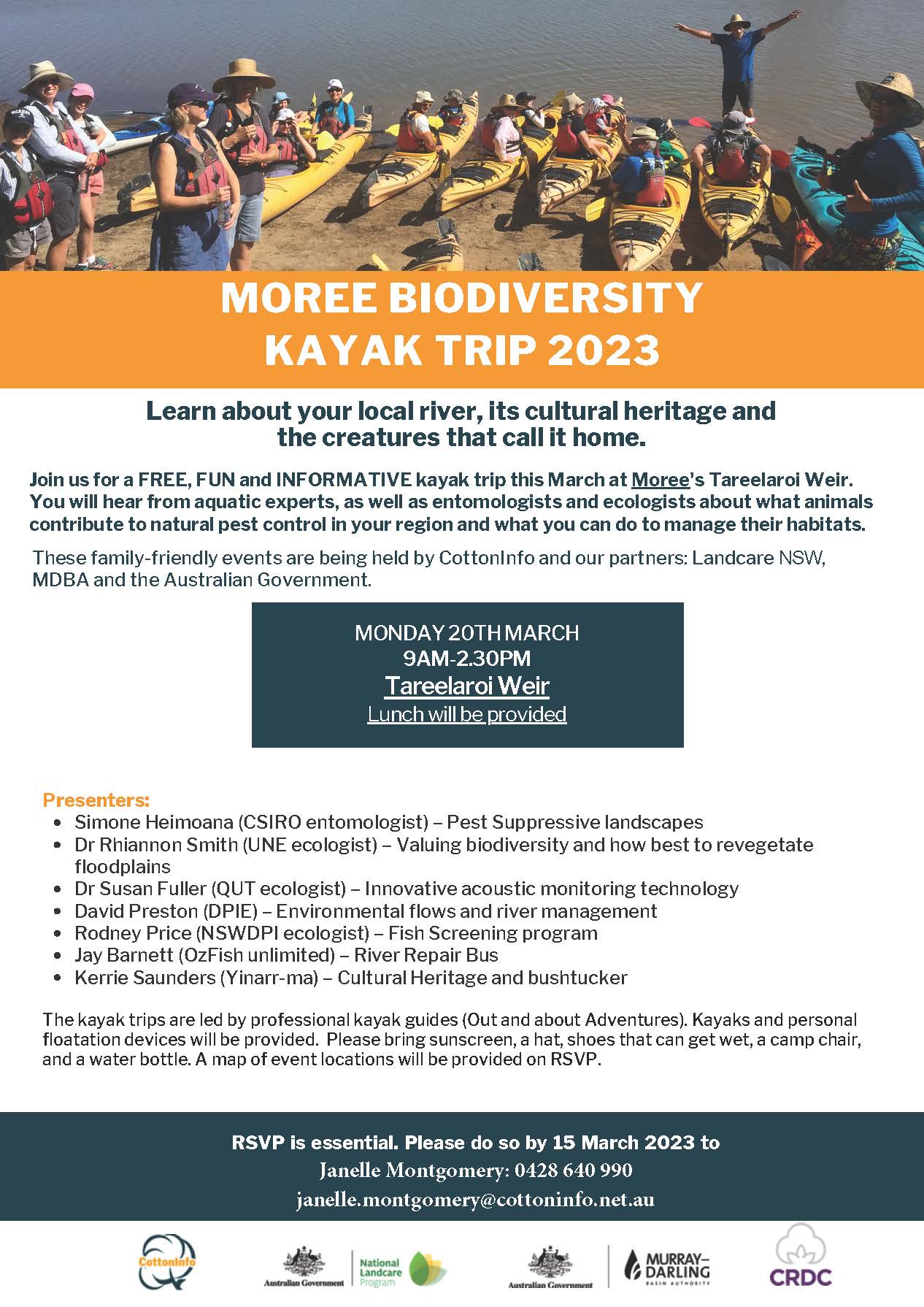
Monday 20th March - Learn about your local river, its cultural heritage and the creatures that call it home.
Join CottonInfo for a FREE, FUN and INFORMATIVE kayak trip at Moree's Tareelaroi Weir. You will hear from aquatic experts, entomologists and ecologists about what animals contribute to natural pest control in your region and what you can do to manage their
habitats.
Presenters: Simone Heimoana (CSIRO entomologist) – Pest Suppressive landscapes, Dr Rhiannon Smith (UNE ecologist) – Valuing biodiversity and how best to revegetate floodplains Dr Susan Fuller (QUT ecologist) – Innovative acoustic monitoring technology David Preston (DPIE) –
Environmental flows and river management, Rodney Price (NSWDPI ecologist) – Fish Screening program, Jay Barnett (OzFish unlimited) – River Repair Bus, Kerrie Saunders (Yinarr-ma) – Cultural Heritage and bushtucker
Sundown Pastoral Company would like to invite you to join them for the 2022 Bayer Grower of the Year Field Day at Keytah, Moree on
21st February 2023
from 10am.
Industry-led panel sessions will explore:
1. Carbon and Greenhouse Gas Emissions.
2. Customer expectations along the value chain.
3. The power of Supply Chain Traceability.
4. Adaptive Agriculture and Innovative Solutions for Growers
5. Practical Applications and Field Innovations
Please see your invitation included. A detailed agenda is available here.
Could you please share this information with your network as this will be a fantastic day where all aspects of the cotton supply chain from
field to fabric will be explored. .
We hope to see you there! Please RSVP for catering purposes.
Tocal College are taking applications for their WHS &
HR Fundamentals course (online).
The course is designed for business owners, managers and supervisors and is delivered as 3 distinct topics (WHS, industrial relations and managing your team) over 16 weeks. It starts Feb 20th, with applications closing Friday (Feb 3rd).
The Australian Government Long-term Trials of Drought Resilient Farming Practices Program is open. The program will support grants valued up
to $8 million per grant. The program will fund innovative and transformational practices that have the potential to positively influence (socially, economically and/or environmentally) the efficiency, productivity, and sustainability of Australian farms from the impacts of drought and climate change.
Projects will test, refine, and demonstrate the effectiveness (or otherwise) of yet to be proven farming practices in a robust scientific
manner. The testing of these practices will underpin and assist to drive widespread adoption through increased evidence and by providing
farmers with the confidence and information they need to try the practices themselves.
Expressions of Interest (EIO) for the Regional Job Creation Fund are open. Attracting new investment to the regions and boosting job security will be the focus of the next round of the NSW Liberal and Nationals Government Regional Job Creation Fund. The Regional Job
Creation Fund will provide grants for regional businesses to expand operations and attract interstate and international businesses to
relocate to regional NSW.
Eligible businesses can apply for grants of between $100,00 and $10 million for projects such as replacing plant equipment, upgrading technology and ensuring businesses that might otherwise have to relocate can remain based in regional areas.
Expressions of Interest for Round Three will close 5pm Monday, 6 March 2023. Successful EOI applicants will be invited to submit
detailed applications from May 2023.
The Gwydir regulated river water allocation update for January has just been released.
There has been improvement in the Gwydir regulated resource allowing for general security water allocation to increase by 11% of entitlement. The increment tops up account balances overall to 759 gigalitres (GL), or approximately 149% of entitlement. Environmental
Contingency Allowance (ECA) is topped-up to its maximum limit requiring just 0.95 GL.
Rainfall in December 2022 was below average across the Gwydir catchment, with Copeton Dam receiving about 25 mm of rainfall in December, and
storage inflows totalled about 10 GL.
The GVIA AGM will be held on Thursday 9th February 2023 at 3:00pm in the GVIA Office 100 Balo St Moree.
The meeting will also be available to members via teams.
The AGM will be followed by a general meeting.
Moree Chamber have forwarded a couple of Flood Impact Surveys. These help inform both local and state governments and may assist in
future aid packages. It is important that these surveys provide information on impacts from businesses across our shire, so we would
appreciate it if you could please complete them - it takes 2 minutes.
The Gwydir is one of the first four regional water strategies that have been finalised by the Department of Planning and Environment. The
plan covers three Priority areas;
1. Water for critical human and environmental needs
2. Sustainable water resources for new and existing users
3. Best use of existing water for the environment
New local intelligence devices available for non-urban water metering
New local intelligence devices available for non-urban water metering reform
Three telemetry-enabled local
intelligence devices
(LIDs) have been listed for use for non-urban metering, including one which can transmit data from multiple meters.
The FlowPRO Multipoint Monitoring System is the first listed LID that supports the transmission of data from multiple meters. It is a
cost-effective solution for water users who can now purchase a single LID for use with up to 4 meters.
Metering and Telemetry Demonstration Project
Landholder participation in the Metering and Telemetry Field Demonstration Project;
The Department of Planing and Environment (DPIE) have had good response from members wishing to participate in the 'Metering and Telemetry Field Demonstration Project' To proceed the DPIE need landholders to sign the 'Landholder Deed'.
The Deed details the obligations of both parties, including work health and safety requirements, confidentiality and the treatment of personal information and special conditions around site access. Contractors are not able to commence any work, including site inspections until the Deed is signed by both parties. The installation schedule is being planned to group sites within geographic locations with a
finite period in which the installations can take place. For participating landholders, the selected floodplain harvesting storages will be equipped with fully installed and compliant floodplain harvesting metering equipment, at no cost. Only those with signed deeds will be able to be included in the project.
Questions about the Deed, or the project, can be directed to: Geordie Worland Fifteen50 Consulting geordie.worland@fifteen50.com.au
0497 279525
NSW Government is requesting landholders impacted by recent flooding to report damages using the Natural Disaster Survey via the link
below.
This information will be used to seek assistance and target the Government's response. It includes and esitimate of crop losses,
infrastructure and repairs.
For isolated members needing emergency assistance for food supplies and medication contact SES 132 500.
The Gwydir River peaked at Gravesend at 11:45pm on Friday 21st October 2022 at a height of 16.20m. as of 10am on Saturday 22nd October 2022 the Gwydir was falling at Gravesend, steady at both Pally and Yarraman. The Mehi was rising in Moree at this time. Please visit the History of Flooding page on our website for more information. Gwydir
Valley Irrigators Association Inc - History Of Flooding (gvia.org.au)
We have also linked to the MPSC website with more information.
For updates on Copeton Dam operations, which is under airspace management and adjusting releasing according to actual and forecast inflows,
you are encouraged to register for the Early Warning Network via WaterNSW the river operators.
WaterNSW operate an Early Warning System for subscribers which provide critical water updates for the state. You can select your
valleys of interest when you register.
This year Mr Bernie George was awarded the prestigious Incitec Pivot Fertilisers Service to Industry Award. Bernie is the Water Services and Compliance Manager at Australian Food & Fibre. Bernie has been delivering excellence in service to the cotton industry
through various high-profile roles for over 30 years. He has worked in the Gwydir having been instramental in the development of the Auscott Midkin aggregation, and has represented various industry organisations including as Chair of the Cotton Australia Board and as a member
of the National Irrigators Council and NSW Irrigators Council. It is wonderful to see Bernie recognised for his committment to the cotton
and irrigation industry.
Keytah was announced as the 2022
Cotton Grower of the Year
at the Australian Cotton Conference. Nick Gillingham, Keytah General Manager along with owners David and Danielle Statham are pictured
receiving the award in August. Sundown Pastoral Company have been actively involved in irrigation efficiency research since 2009, they have
willingly shared their experiences and understanding to help other producers adopt new and innovative technologies. The team are also
farming St Ronans in Qld and have been instrumental in the creation of the Good Earth
Cotton
Company and FibreTrace. This award is well deserved and highlights that the
Gwydir is still at the forefront of the Australian Cotton Industry.
At last NSW DPE recently confirmed that there is a new exemption for metering conditions for "works used solely
to take water under a basic landholder right".
This means, groundwater works in particular those that have an water access licence attached to the work ("the bore") but
you do not use it to irrigate, rather you only use it for stock and domestic purposes are now exempt from metering requirements. This
exemption is welcomed considering the cost implications for individuals with little benefit to the reform outcomes, as there is no water
being used for irrigation anyway.
You may want to inform WaterNSW to tag your work as not active for irrigation, however it is not a requirement.
The below link refers to all the current exemptions available.
A reminder to ask members to keep their membership details current with the GVIA, including you current licence share information and subcatchment. We are due to embark on this years membership request and ask that if you have made changes by buying or selling shares,
to please let us know. We will also be looking to send this invoice electronically, so please ensure we have the appropriate email on
file - if you want to add a new email just ask or create a new contact via the website.
With licences now delivered for regulated and unregulated floodplain harvesting, we also ask that you please provide the GVIA with
these details, particularly licence type (regulated or unregulated), unit shares and management zone information for our member
records.
All of this information will assist us in ensuring we can keep our records current, target communications and keep you informed. All
member information is confidential
NSW DPI Fisheries is seeking Expressions of Interest (EOIs) from water users who would like financial and logistic assistance to upgrade their water diversion (pump or gravity-fed channel) with a modern fish-protection screen.
Modern screens keep fish and debris where they belong – in the river and out of infrastructure. They feature a large self-cleaning surface
area that maintains the volume of water extracted, while using a fine mesh that limits the extraction of fish from our rivers.
We encourage all members with surface water offtakes to apply, regardless of whether you are located in the priority area along the
Mehi River or not.
Applications are easy - just your works details and descriptions. Visit the website for more information EOI
- Fish Screens Australia
Water NSW have announced a rescheduling of the regulator works at Tarelaroi Weir until April 2023.
Works to have the regulator back fully operational will need to occur prior to the commencement of this season's delivery which will result in a 1-2 week shut down period for the Mehi/Moomin. The gates must be properly reinstalled to allow full operations.
WaterNSW confirmed today that all the approvals have been implemented to enable floodplain harvesting licences in the Gwydir Regulated
River Water Source and the Gwydir Unregulated Water Sources, where there is a licence with allocation available to take water.
The announcement confirmed that these licences can be used provided the total storage in Menindee Lakes is greater than 195GL. The Menindee Lakes currently have a total of 1,958 GL storage or at 113% capacity, which is 1000 times more water than the drought
limit triggers which restrict floodplain harvesting access. Restrictions are also removed when local in-valley flow targets can be achieved,
these our outlined for each management zone in the WSP.
For a copy of the announcement, visit WaterInsights.
DPE have made an allocation announcement for supplementary entitlements of 0.79 megalitres per unit share brining supplementary entitlements
to 100% availability, this has come in response to the issuing of replacement floodplain harvesting licences in the regulated and
unregulated water sources with water availability of 1 megalitre per unit shares. These licences are now fully enabled.
This for the first time brings all licences into the water management framework and with 100% availability for all forms of take with
general security accounts at their maximum of 150%.
I'll note Copeton Dam remains on spill operations to maintain capacity to 100% and more information is available on our webpage linked below.
Measurement requirements for FPH are due to begin - what do you need to do and by when?
If wanting to take FPH water immediately - licence holders must demonstrate that they can measure any take using one of the current approved
pathways. You must visit iWas and take steps to initiate a measurement period within 24 hours of taking water.
However, as each device must be benchmarked and linked to the storage curve in the DQP portal, this is unlikely to be achievable
immediately.
We recommend that a 91i
form - self reporting of water take is lodged to demonstrate how you will be measuring take and reporting on iWas.
NSW DPE emailed the licence conditions and work approvals for the issuing of replacement floodplain harvesting licences on Friday. They
plan to make the final approvals to activate FPH licences today, 15 August 2020. A water allocation announcement, for floodplain harvesting and for supplementary licences is also expected.
Members receiving a replacement FPH licence should check WaterNSW's iWas system as these licences should now be visible with your other
entitlements.
NSW DPE will be consulting on updated groundwater trends and modelling outcomes in September 2022, to included updated climate and usage information and new scenario testing. This is in response to feedback during the consultation last year on managing groundwater
decline in the region.
Note the DPE website indicated that for the Lower Gwydir groundwater source:
On 1 July 2022 there will be no change in the groundwater trading assessment process in the Lower Gwydir groundwater
sources.
We plan to meet with stakeholders in the Lower Gwydir groundwater sources in September 2022 to undertake further consultation on what
decisions the department may make to manage and limit groundwater level declines.
Any change in the trade assessment processes will apply from the start of a water year, ie not before 1 July 2023.
In a milestone for water management in the region, the NSW Water and Environment Minister’s jointly amended the Gwydir’s water sharing plans
to include floodplain harvesting, the take of water during floods.
This is the final form of water in the region to be licensed and has taken 20 years of delays and deliberations with licences to begin by 1
September 2022.
Zara Lowien, the Executive Officer of the Gwydir Valley Irrigators Association whose members will be the first in NSW to be licenced for
this form of take said this is not a win for northern irrigators, as it's often portrayed.
"On average water users in the Gwydir are losing 30% of their long-term access to flood water which will have more than a $90 million impact to our economy through less production" she
said.
"Make no mistake, this is an environmental reform like no other.”
NSW Government agencies are holding a information session for eligible floodplain harvest licence holders in Moree on Tuesday, 2nd August 2022. Starting at 9:30am at the Moree Services Club.
This meeting is to provide you with the information to meet your new regulatory requirements - administration, measurement and reporting of
these licences, which will be issued no later than 1 September 2022.
It is a must attend meeting for all floodplain harvesting members and you will need to RSVP to the Department here.
The Water Sharing Plan for the Gwydir Regulated River Water Source and the Gwydir Unregulated Water Sources were amended and made
available on Friday, 29 July 2022.
The updates include the floodplain as a source of water and the new account management, access and dealing rules for replacement floodplain harvesting licences which are due to commence no later than 1 September 2022. This is a major milestone for the near completion of the Healthy Floodplains Program in our region.
Update were also made to make these plans consistent with rules for the Basin Plan.