GWYDIR VALLEY IRRIGATORS ASSOCIATION

GWYDIR VALLEY IRRIGATORS ASSOCIATION
In February 2026 the MDBA released the Murray Darling Basin Plan Review Discussion Paper. This is the fifth paper informing the review. This includes:
The discussion paper indicates that after more than a decade, there are still challenges to achieving Basin Plan outcomes. Through the Basin Plan Review the MDBA are looking at whether change is needed to make the Basin Plan work as efficiently and effectively as possible. They are looking for options to make the Basin Plan more outcomes focused.
The Basin Plan review will result in recommendations to Basin governments on how the Plan should adapt.
The change for GVIA members is to consider mechanisms or options put forward by the MDBA. The primary question we will be asking how can
the new basin plan deliver better environmental outcomes while respecting water entitlement. The new basin plan must
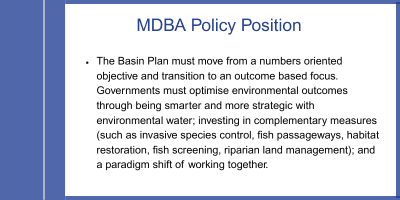 environmental outcomes
Better outcomes from existing Environmental Water
The new Basin Plan should focus on delivering better outcomes from existing $13B water investment through a prioritised and adaptive plan of Basin management. This will require a shift in thinking with community partnerships at the centre. This should incorporate:
There is no need for additional water, the new plan needs to ensure that the environmental outcomes from existing water are
enhanced, and that critical human needs are more secure though a more comprehensive look at solutions, including infrastructure (storage
dams, weirs, pipelines, tanks), secondary supply sources, water recycling or desalination. This will require partnerships with local
councils, who are primarily responsible for town water supply.
The new direction must:
Managing for climate change is not about ensuring a set of benchmark environmental outcomes in the Basin continue to be achieved. All users
must share risks and opportunities.
When referring to ‘plausible climate futures’, this must include both wetter and drier periods, as well as acknowledge the uncertainty in
projections.
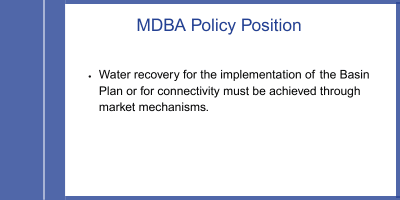
Strategy must move from changing rules in sharing plans to integrated land and water management. It is time to stop asking
the same people to be the solution and make this a broader community commitment.
Community and Agriculture
The Basin Plan has had significant, and observable, impacts on communities, especially where there is a high dependence on irrigated
agriculture.
Socio-economics must be prioritised to inform decision making on future steps for Basin Plan water management.
.png)
| SEIFA |
2006 |
2011 |
| education and occupation |
5 |
↓ to 3 |
| advantage and disadvantage |
5 |
↓ to 3 |
| Economic resources |
4 |
↓ to 2 |